
Everyone arrives in Puglia with a version of Italy already in their head — the one built from films and cookbooks and a hundred other people's photographs. Puglia dismantles that version quietly, without drama, and replaces it with something better.
Alberobello and the Trulli
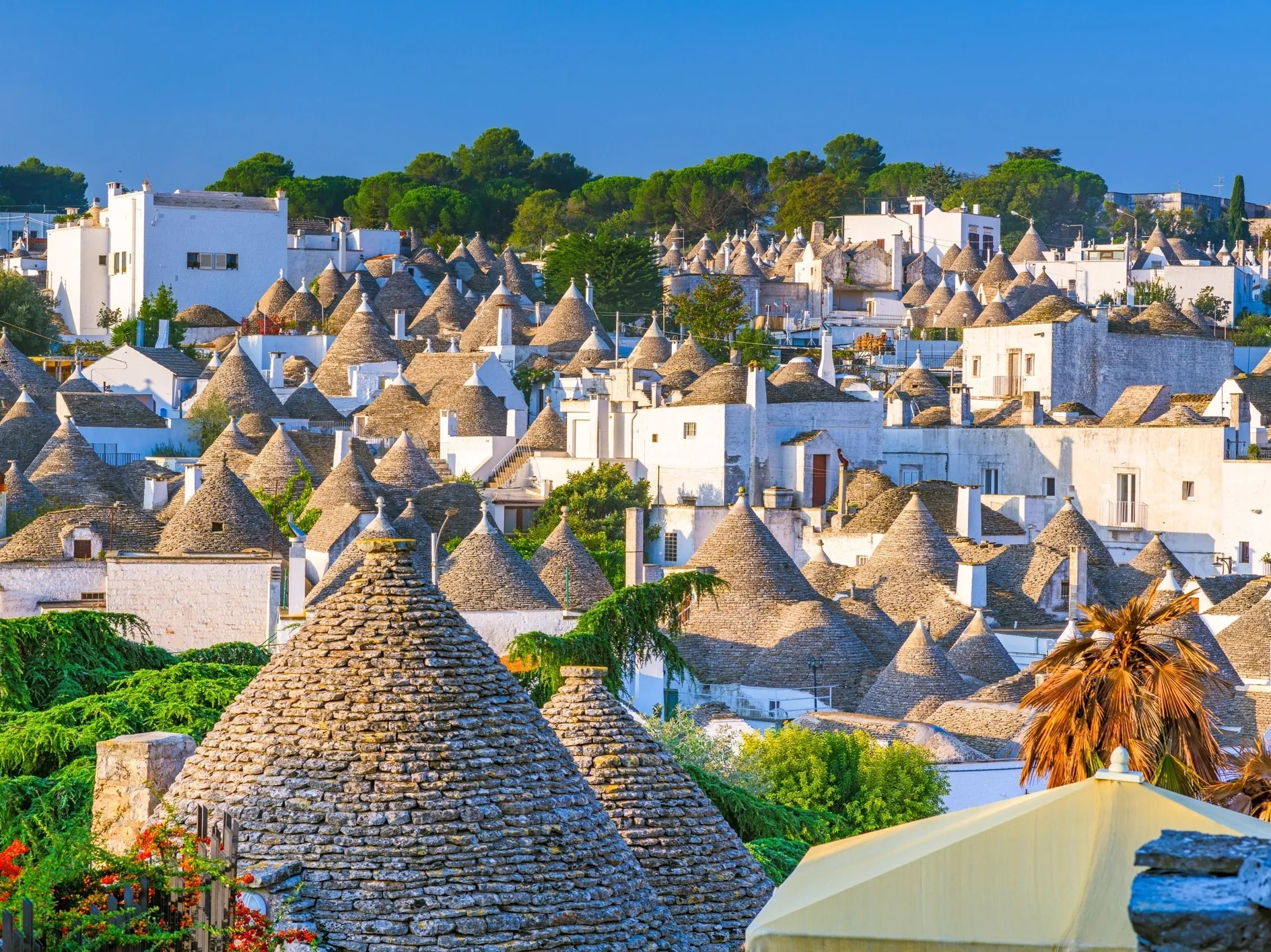
The trulli of Alberobello are genuinely strange — conical stone houses with whitewashed walls and grey limestone roofs, built without mortar so they could be dismantled quickly to avoid taxation. The story is probably apocryphal but the buildings are absolutely real, and walking through the Rione Monti district at dusk, once the day trippers leave, enjoying aperitivo on a quiet side street, is one of the more quietly surreal experiences available in Puglia.
We stayed in a trullo in the town itself — the circular room, the thick walls, the small window that framed a courtyard. Each morning the owner came in and prepared breakfast herself: local bread, preserves, fruit, meats, cheeses, yogurt and pastries. It is the kind of accommodation that is uniquely different from anything else and the kind of hospitality that we've experienced many times in Italy where you feel embraced.
The Olive Groves
Puglia produces more olive oil than any other region in Italy, and the trees here are ancient — some of them over a thousand years old, their trunks twisted into shapes that look more like sculpture than agriculture. Driving through the groves in the early morning, the light filtering through silver-green leaves, is one of those experiences that does not translate into photographs but stays with you anyway.
What surprised us as much as the trees themselves were the rock walls — ancient dry-stone boundaries running between the groves, and beautiful villas set back from the road behind iron gates and bougainvillea — its vivid cascades of magenta and deep pink adorning whitewashed walls and wrought iron as though they were always meant to be part of the architecture. The landscape feels as though it has been left largely to itself — ancient and unhurried in a way that is hard to find elsewhere in Italy, and harder still to forget.
Ostuni
Ostuni sits on a hill above the olive groves, its whitewashed buildings stacked so tightly against each other that from a distance the whole town looks like a single pale mass against the sky. It is called the White City, and the name is entirely accurate — every surface is washed the same brilliant white, the narrow streets winding upward between walls that seem to glow in the afternoon heat.
We spent a morning walking its lanes, peering into bakeries stacked with every variety of focaccia and taralli. The town is full of things made from olive wood — bowls, boards, small objects worn smooth by handling — and it is very difficult to leave without several of them. Ostuni rewards an early arrival and a slow pace; by midday the main streets fill quickly, but slip down the quieter alleys above the cathedral and you find the most picturesque settings — art adorning walls, bicycle baskets filled with flowers, and small cafes with just a few tables where you can linger over a meal well into the afternoon.
Matera
Matera sits just over the border in Basilicata, but no trip to this part of southern Italy is complete without it. The Sassi — the ancient cave districts carved into the ravine — are among the oldest continuously inhabited settlements in the world, and nothing quite prepares you for the first view of them: tier upon tier of stone dwellings descending into the gorge, churches hollowed from the rock, staircases connecting levels that have been in use for nine thousand years. Filmmakers have long understood what the place communicates — Mel Gibson chose it as the setting for The Passion of the Christ, and standing across the ravine looking at the Sasso Caveoso, it is not difficult to understand why.
Walk down into the Sasso Caveoso in the early evening when the light turns the stone amber and the day-trippers have gone. The church of San Pietro Caveoso is there at the base of the ravine, its facade facing the gorge, carved into and built from the same rock as everything around it — a church that feels less like a building than a continuation of the landscape. The silence in that part of the Sassi at dusk is remarkable for a UNESCO World Heritage site.
What makes Matera genuinely unlike anywhere else is the option to sleep inside it. A number of the cave dwellings have been restored as boutique hotels and small guesthouses — rough limestone walls, vaulted ceilings, rooms that have been inhabited in some form for millennia. Staying in one changes the experience entirely. You are not visiting the Sassi; you are waking up inside them, and that is a different thing altogether. Walking the empty streets at first light, when the stone is cool and the city belongs entirely to you, is one of those rare travel experiences that stays with you long after you have left — a reminder of just how extraordinary a place built by human hands over nine thousand years can be.
Polignano a Mare
The drive out to the coast is part of the experience. The road winds through the interior — past cherry trees heavy with fruit, dry-stone walls, and groves that seem to go on without end — before the landscape opens suddenly onto the sea.
Polignano a Mare is built on a cliff above the sea, and the coastline here is unlike anything else on the Adriatic — the town sits on a limestone promontory, and below it the rock drops sheer into coves of extraordinary turquoise water. You can walk the perimeter of the old town and look down from different angles, each one a slightly different version of the same impossible view. The sea catches the light differently at every hour.
We stayed at Sei Stelle Mama, a small boutique hotel right on the town square, which meant we had a front-row seat to the rhythm of the place — locals going about their morning, tourists arriving wide-eyed by afternoon, the square shifting character by the hour. The seafood here was the best either of us had eaten anywhere — simply prepared, impossibly fresh, the kind of meal that recalibrates your expectations and makes every seafood dish you eat afterwards a little harder to enjoy.
Puglia is not the Italy most people picture when they first think of the country. There are no grand galleries, no famous fountains, no single landmark that draws the crowds. What it offers instead is something harder to define and more difficult to forget — landscapes that shift from ancient olive groves to dramatic coastline, towns of whitewashed stone and cave-carved rock, architecture unlike anything else on the peninsula. It is a region that reveals itself gradually, and Puglia has a way of offering you something unexpected that turns out to be the thing you remember most.
Puglia rewards the traveler who arrives without assumptions and leaves with a completely different idea of what Italy can be.
The best time to visit is May to June or September to October — warm enough for the coast, cool enough for walking, and without the August crowds that transform the most popular towns.