
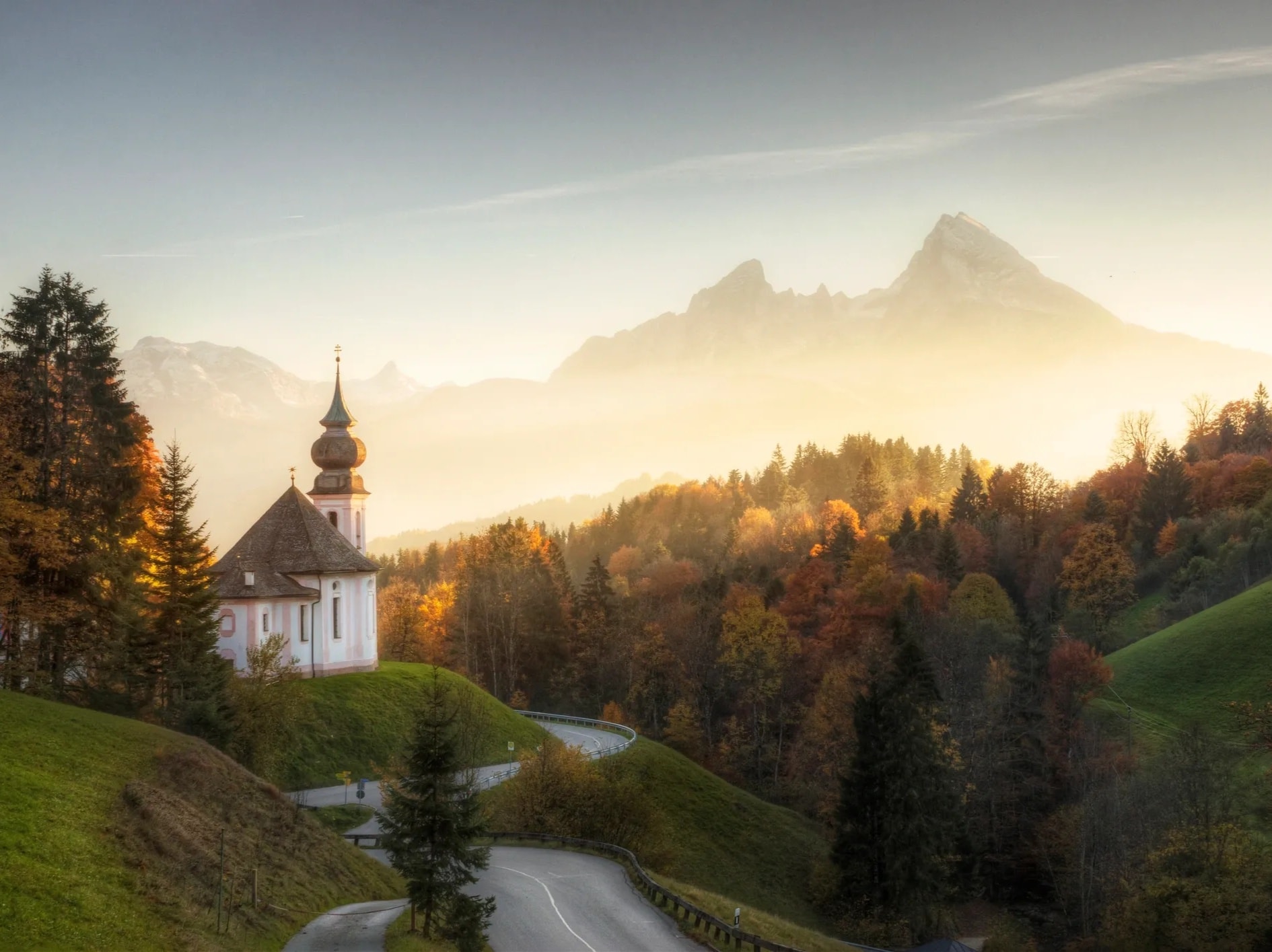
Bavaria is one of those places that has been so thoroughly photographed that you arrive with a complete image of it already formed. The castles, the beer halls, the Alps, the lederhosen. What the photographs do not prepare you for is how much of Bavaria exists outside the frame.
Neuschwanstein (and Getting Past It)
You have to do Neuschwanstein. It is extraordinary — a nineteenth-century fantasy castle built by a king who was probably mad, perched on a cliff above a gorge with the Alps behind it, looking exactly like the castle in every fairy tale you have ever read. Go early, buy tickets in advance, and accept that you will be sharing the experience with several thousand other people.
Then drive south into the Allgau and leave them all behind. The road through the Allgau — the region between the Bavarian Alps and Lake Constance — is one of the great drives in Germany: rolling green hills, dairy farms, small towns with onion-domed churches, and almost no other tourists. We drove it on a Tuesday in June and stopped four times for no reason other than that the view demanded it.
The Breweries
Bavaria has over six hundred breweries, and the tradition of brewing here is not a marketing concept but a genuine cultural practice, governed by the Reinheitsgebot — the purity law of 1516 that specifies that beer may be made only from water, barley, and hops. Many of the small family breweries have been operating continuously for centuries.
We visited the Braustüberl Tegernsee, a brewery tavern on the shores of the Tegernsee where the tradition of brewing dates to 1675, when the monks of Tegernsee Abbey first began making beer here. You feel that history the moment you walk in — but what strikes you more is the atmosphere. It is unpretentious and vibrant, full of Bavarian coziness and a pub culture that feels entirely alive, the kind of place where the way of life of a region makes itself known without trying to. Alongside the beer we worked our way through the local food, and somewhere between the first glass and the last plate it started to feel a bit like coming home.
Munich
Munich is the capital of Bavaria and one of the great cities of Europe — prosperous, beautiful, and with a character that expresses itself in extraordinary museums, excellent restaurants, and a beer garden culture that treats the consumption of a litre of lager in a public park as a perfectly reasonable way to spend a Tuesday afternoon.
A beer tour is one of the best ways to find your footing in the city — to learn the lay of the land, sample great food and beer, and meet the locals over a shared table in the beer garden. In a beer garden you share long tables with whoever happens to be there — that is simply how it works, and it is part of the charm. You never quite know who you will end up sitting beside. We found ourselves in easy conversation with two old friends who were visiting from Düsseldorf — genuinely warm and welcoming, the kind of exchanges that stay with you long after the trip is over.
The Englischer Garten is larger than Central Park and contains, among other things, a river wave where surfers ride a standing wave in the middle of the city. The Marienplatz market is the kind of place that reminds you why local food culture matters — stalls piled with produce, cheeses, breads, cured meats, and preserves, everything farm to table and sourced from the surrounding region. You can spend an hour there and leave with enough for a very good picnic, or simply wander and eat as you go. Munich rewards time.
Bavaria keeps surprising you the further you go. Oberammergau draws you in with its extraordinary painted houses — entire facades covered in elaborate frescoes depicting biblical scenes and folk tales, a tradition that has been part of the town's identity for centuries. Berchtesgaden sits in one of the most dramatic Alpine settings in Germany, where the crystalline Königssee stretches between sheer rock walls, and the Eagle's Nest — Hitler's mountaintop retreat, perched at 1,834 metres with views across the Alps into Austria — offers a sobering and fascinating window into the history of the Third Reich. Garmisch-Partenkirchen sits at the foot of the Zugspitze, Germany's highest peak, and the surrounding valleys, castles, and landscapes could fill a week without effort. This article has barely scratched the surface. Bavaria is one of those places that keeps giving — breathtaking in its landscapes, deep in its history, and generous in the way it welcomes people who take the time to explore it properly.
There is a back road through the Allgau with no other cars, a brewery that has been in the same family since 1630, and a village square where the afternoon simply refuses to end.
Avoid October if you want to avoid Oktoberfest crowds — the city is extraordinary but the tourist pressure is intense. May and June, or September before the festival begins, are ideal.