
Art & History
Historical Castles
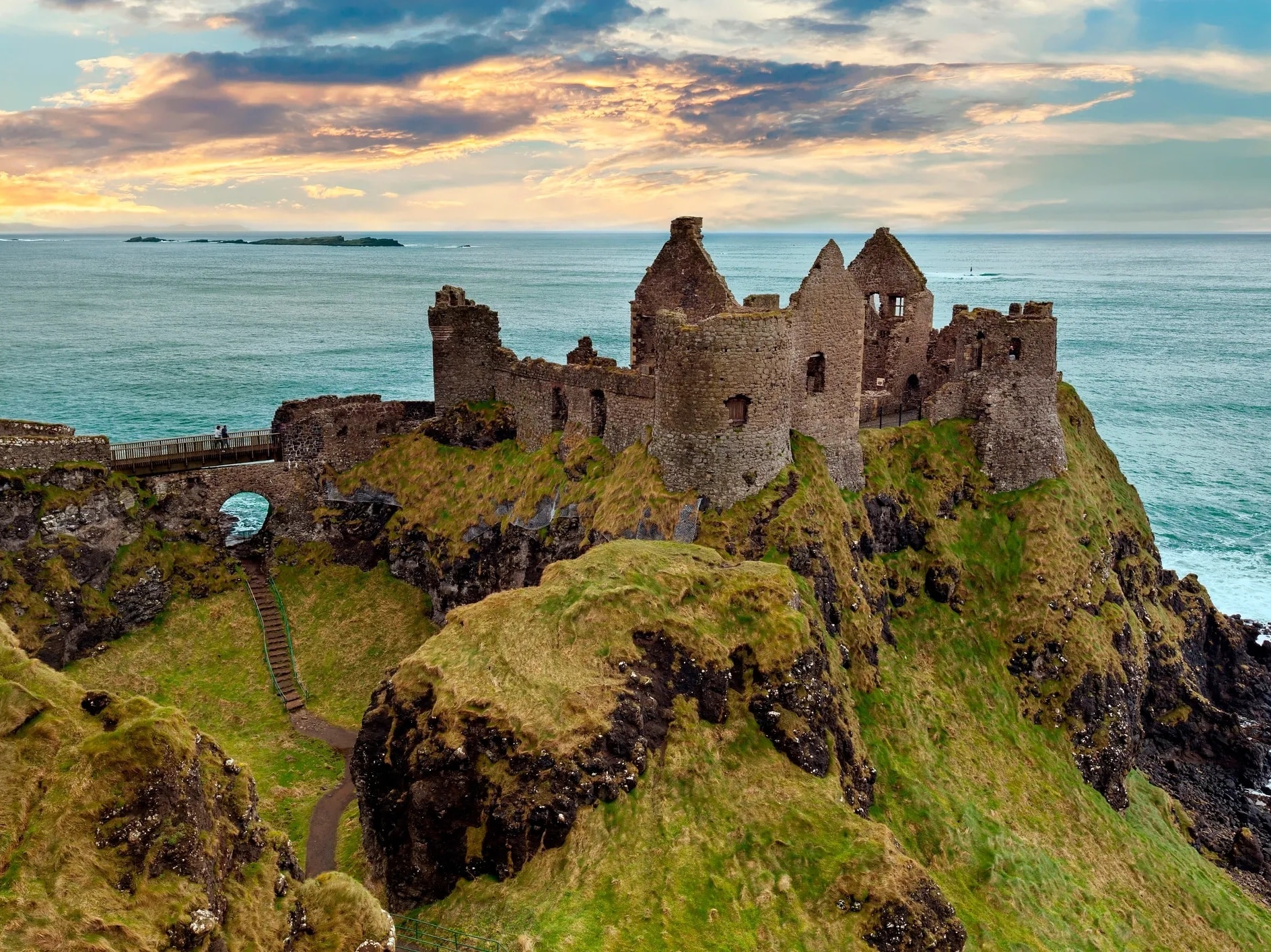
Dunluce on its clifftop, Dunnottar above the North Sea, Tintagel on the Cornish headland — the great ruined fortresses of Europe. Sometimes you feel a chill from the history that took place here, a lesson taught through touching the stones.
The most affecting castles in Europe are not the ones that have been restored and furnished and opened to the public with gift shops and audio guides. They are the ones that have been left to the sky — roofless, windswept, their walls still standing above a cliff or a plain or a river, their history legible in the stonework for anyone who takes the time to look. Dunluce Castle on the north Antrim coast of Ireland is perhaps the most dramatically sited of all: a cluster of towers and walls perched on a basalt outcrop above the Atlantic, connected to the mainland by a narrow bridge, one of its towers having fallen into the sea during a storm in 1639 — the kitchen staff, according to local tradition, going with it. It was the seat of the MacDonnell clan, who controlled the sea routes between Ireland and Scotland for centuries, and its position above the waves makes it feel less like a ruin than like a place that the sea is slowly reclaiming. Trim Castle in County Meath is the largest Anglo-Norman castle in Ireland — a massive keep surrounded by a curtain wall enclosing three acres, built by Hugh de Lacy in the twelfth century and used as a location for Braveheart; it sits above the River Boyne in a town that has barely grown since the medieval period, and can be explored in almost complete solitude on a weekday morning. The Rock of Cashel in Tipperary is something else again — a cluster of Romanesque and Gothic buildings on a limestone outcrop rising from the plain of Munster, including a round tower, a cathedral and Cormac's Chapel, the finest Romanesque building in Ireland, all abandoned to the sky in the seventeenth century and left exactly as they fell.
In Scotland, Dunnottar Castle stands on a headland above the North Sea south of Stonehaven — a promontory of rock almost entirely surrounded by water, its gatehouse and keep and great hall all ruined but still standing, the sea visible through every window and doorway. It was here that the Scottish Crown Jewels were hidden from Cromwell's army in 1651, smuggled out by a minister's wife concealed in her clothing, and it is here that the full drama of Scottish history feels most present — not in a museum but in the wind and the spray and the sheer improbability of the place. Eilean Donan on the western coast, where three sea lochs meet at the foot of the Highlands, is the most photographed castle in Scotland and one of the most photographed buildings in Britain — a thirteenth-century island fortress connected to the shore by a stone bridge, its reflection in the still water of Loch Duich on a calm morning one of the defining images of the country. Urquhart Castle on the western shore of Loch Ness is a ruin of considerable scale — a tower house, a gatehouse and the remains of a great hall spread across a promontory above the loch — and the setting, with the dark water stretching away into the distance and the mountains rising on the far shore, is one of the finest in the Highlands.
In England, Tintagel on the north Cornish coast is associated with the legend of King Arthur — whether or not the historical Arthur ever stood here, the headland above the Atlantic, with its ruined medieval castle and its Iron Age and Roman remains, has the quality of a place where myth and landscape have become inseparable. The new footbridge connecting the two halves of the headland, opened in 2019, makes the site fully accessible for the first time in centuries; the views from the castle walls, with the sea breaking on the rocks two hundred feet below, are among the most dramatic in England. St Mawes Castle in Cornwall, built by Henry VIII in the 1540s as part of his coastal defence programme, is a different kind of English castle entirely — a low, rounded artillery fort in a garden setting above the Fal estuary, its clover-leaf plan designed for cannon rather than archers, its stonework carved with Latin inscriptions flattering the king. It is one of the best-preserved Tudor castles in England and one of the least visited, its position at the end of a peninsula accessible only by ferry from Falmouth giving it a quietness that most historic sites of its quality have long since lost.
In France, the Loire Valley is better known for its pleasure chateaux, but its fortresses tell an older story. Chinon, where Joan of Arc first met the Dauphin in 1429 and persuaded him to give her an army, is a vast ruined complex on a cliff above the Vienne — three separate castles joined by curtain walls, its great hall now open to the sky, its towers still standing above the river and the town. Loches, further east, is one of the best-preserved medieval royal residences in France: a keep built in the eleventh century by Fulk Nerra, Count of Anjou, surrounded by a walled town that has barely changed since the Middle Ages, its dungeons still containing the iron cages in which Louis XI kept his enemies. In Spain, the Alcazar of Segovia rises from a rocky promontory at the confluence of two rivers like the prow of a ship — a castle of Moorish origin rebuilt by the Castilian kings into one of the most recognisable silhouettes in Europe, its pointed slate towers the model, it is said, for the castle in the original Disney logo. Coca Castle in the province of Segovia is something rarer: a fifteenth-century Mudejar fortress built entirely of brick in a style that blends Gothic and Islamic architecture into something found nowhere else in Europe, its moat and towers and elaborate brickwork in a state of extraordinary preservation. Penaranda de Duero and the castles of the Castilian meseta complete a landscape of fortification that stretches across the high plateau of central Spain — a reminder that this was, for centuries, a frontier between Christian and Moorish worlds, and that every hilltop here was once a strategic position worth dying for.
What unites all of these places — the clifftop ruin, the island fortress, the Mudejar tower — is the way they bind landscape and history into a single experience. These are castles that were never merely buildings; they were statements about power, survival and belonging, made in stone, in positions chosen for drama as much as defence, and left for us to read in the wind and the light.
Sometimes you feel it before you understand it — a chill that moves through you in a doorway, or the sensation of pressing your hand to a stone and knowing, without words, what happened here. History taught not through a screen or a caption, but through the cold weight of the wall itself.
Interested in exploring historical castles with us?
Plan Your Journey