
Art & History
Grand Palaces
Versailles, the Alhambra, Schonbrunn — the great seats of royal and imperial power, built to astonish, still doing exactly that.
If there is a single building that defines the European idea of royal power made visible, it is Versailles. Louis XIV began transforming his father's hunting lodge in 1661 and did not stop for fifty years — the result is a palace of 2,300 rooms set in formal gardens of such scale that they required their own hydraulic system to keep the fountains running. The Hall of Mirrors, completed in 1684, stretches seventy-three metres along the garden facade, its seventeen arched mirrors reflecting seventeen arched windows and the gardens beyond — a room designed not for comfort but for the performance of absolute monarchy. The gardens themselves, laid out by Andre Le Notre, are a masterpiece of controlled nature: parterres, canals, fountains, bosquets and the Grand Trianon all arranged along a central axis that runs to the horizon. To walk Versailles properly takes a full day, and most visitors see only a fraction of it. The Petit Trianon, built for Madame de Pompadour and later given by Louis XVI to Marie Antoinette, is a study in the reaction against all that grandeur — intimate, neoclassical, surrounded by an English landscape garden that Marie Antoinette designed herself, with a working hamlet where she could pretend, briefly, to be someone else. The Loire Valley chateaux that preceded Versailles as the seat of French royal power are a different kind of spectacle — not the concentrated force of a single vision but the accumulated pleasure of a dynasty that moved from house to house with the seasons. Chambord, begun by Francis I in 1519, has 440 rooms and a double-helix staircase attributed to Leonardo da Vinci, its roofline a forest of chimneys, turrets and lanterns that looks from a distance like a city skyline. Chenonceau spans the River Cher on a series of arches, its gallery stretching across the water, its gardens laid out on either bank — a building that has belonged to a succession of remarkable women, from Diane de Poitiers to Catherine de Medici to Louise Dupin, who sheltered Rousseau there during the Revolution.
The Alhambra in Granada is the most visited monument in Spain and, by most measures, the most beautiful palace complex in Europe. Built by the Nasrid sultans of Granada between the thirteenth and fifteenth centuries on a red hill above the city, it is not one building but a sequence of palaces, gardens, towers and a summer residence — the Generalife — all arranged around water, light and the sound of fountains. The Nasrid Palaces at its heart are the supreme achievement of Moorish architecture: the Court of the Lions, with its twelve marble lions supporting a central fountain and its surrounding arcades of carved stucco so intricate they seem to dissolve the wall into lace; the Hall of the Ambassadors, its domed ceiling a map of the seven heavens of Islamic cosmology; the Comares Tower, from whose windows the sultans looked out over the city they ruled and the plain of the Vega stretching to the horizon. The Alhambra was taken by Ferdinand and Isabella in 1492 — the same year they expelled the Jews and sent Columbus west — and the Catholic Monarchs were so overwhelmed by what they found that they ordered it preserved rather than demolished. Charles V later built a Renaissance palace in the middle of the complex that is jarring in its contrast, but even that cannot diminish what surrounds it.
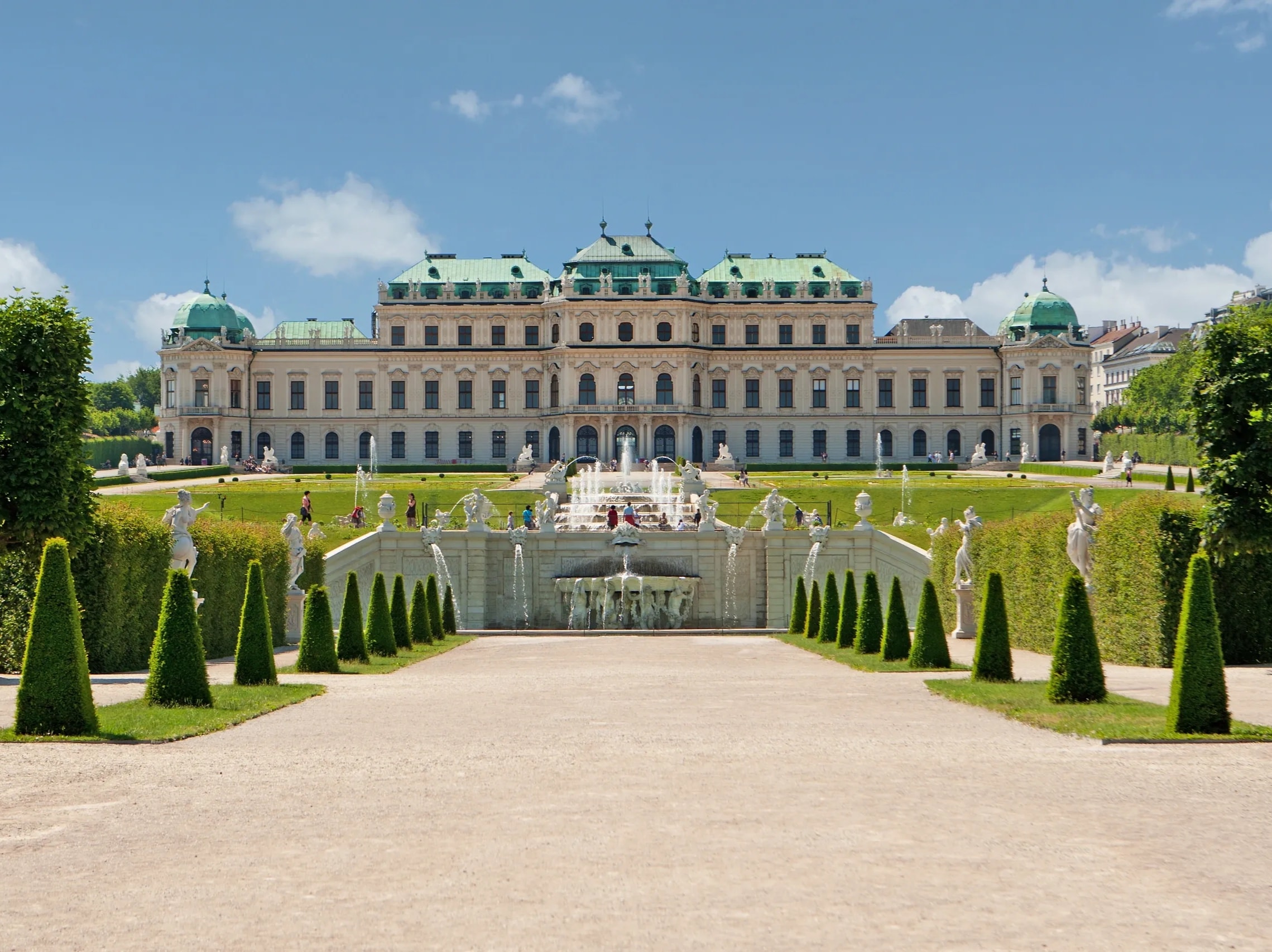
In Vienna, the Habsburg emperors built on a scale that matched their ambition. Schonbrunn, the imperial summer palace with its 1,441 rooms and formal gardens climbing to a hilltop colonnade with views back over the city, was conceived as a rival to Versailles and in some respects surpasses it — the gardens are more intimate, the setting more dramatic, and the palace itself more liveable, its rooms still carrying the particular atmosphere of a place that was actually used, by actual people, for centuries. The Belvedere, built for Prince Eugene of Savoy — the greatest military commander of his age, who had defeated the Ottomans at the gates of Vienna and driven them back across the Balkans — is a baroque masterpiece in two parts: the Upper Belvedere, now home to Klimt's The Kiss and one of the finest collections of Austrian art in the world, and the Lower Belvedere, set in formal gardens of cascading fountains and clipped parterres that descend between the two palaces in almost complete quiet. Together they make Vienna one of the great palace destinations in the world.
No monarch since Louis XIV built more obsessively or more beautifully than Ludwig II of Bavaria, and the castles he left behind are among the most extraordinary buildings on the continent — not because they are ancient, but because they are the pure expression of a single, consuming imagination. Neuschwanstein, begun in 1869 on a rocky outcrop above the Alpsee, was conceived as a stage set for Wagnerian opera made real: its towers and turrets rising from the forest like something from a fairy tale, its interior a sequence of rooms painted with scenes from the Ring Cycle and Parsifal that Ludwig himself would never see completed. He lived there for only 172 days before being declared insane and removed from power; six days later he was found dead in a lake. Linderhof, his only completed palace, is smaller and stranger — a rococo jewel in a Bavarian valley modelled on the Petit Trianon, with a grotto in the grounds lit by coloured electric lights where Ludwig would be rowed across an underground lake in a gilded boat at night, alone, listening to music. Herrenchiemsee, built on an island in the Chiemsee, is his most audacious project: a full-scale replica of the Hall of Mirrors constructed in the middle of a Bavarian lake and never finished, its endless gilded gallery stretching into the distance with no one to walk it. Ludwig spent his entire civil list and borrowed ruinously against the Bavarian state to build these places; he was declared insane not because he was mad but because he was inconvenient, and the castles he left behind are the most visited buildings in Germany after Cologne Cathedral. To stand in the Hall of Mirrors at Herrenchiemsee — alone, if you time it right, in the early morning before the tour groups arrive — is to understand something about the relationship between beauty and obsession that no other building in Europe quite teaches.
There is a particular feeling that comes over you in these places — a sense of your own smallness that is not diminishing but clarifying. You stand in a hall built to hold a court of thousands, beneath a ceiling painted with the victories of kings, and the scale of it does something to your sense of proportion that no photograph prepares you for. These were not buildings designed for comfort or for ordinary life; they were designed to make the person standing in them feel exactly this — dwarfed, astonished, briefly uncertain of the century. And yet the marvel is not only the excess. It is the craft that went into every gilded cornice, every clipped parterre, every fountain timed to the movement of the sun. To walk through Versailles or the Alhambra or Schonbrunn is to be in the presence of human ambition at its most concentrated — and to come away not humbled so much as enlarged, carrying the memory of what it felt like to stand inside something built on that scale, and to have found it, against all expectation, beautiful.
Interested in exploring grand palaces with us?
Plan Your Journey