
Art & History
Grand Houses & Gardens
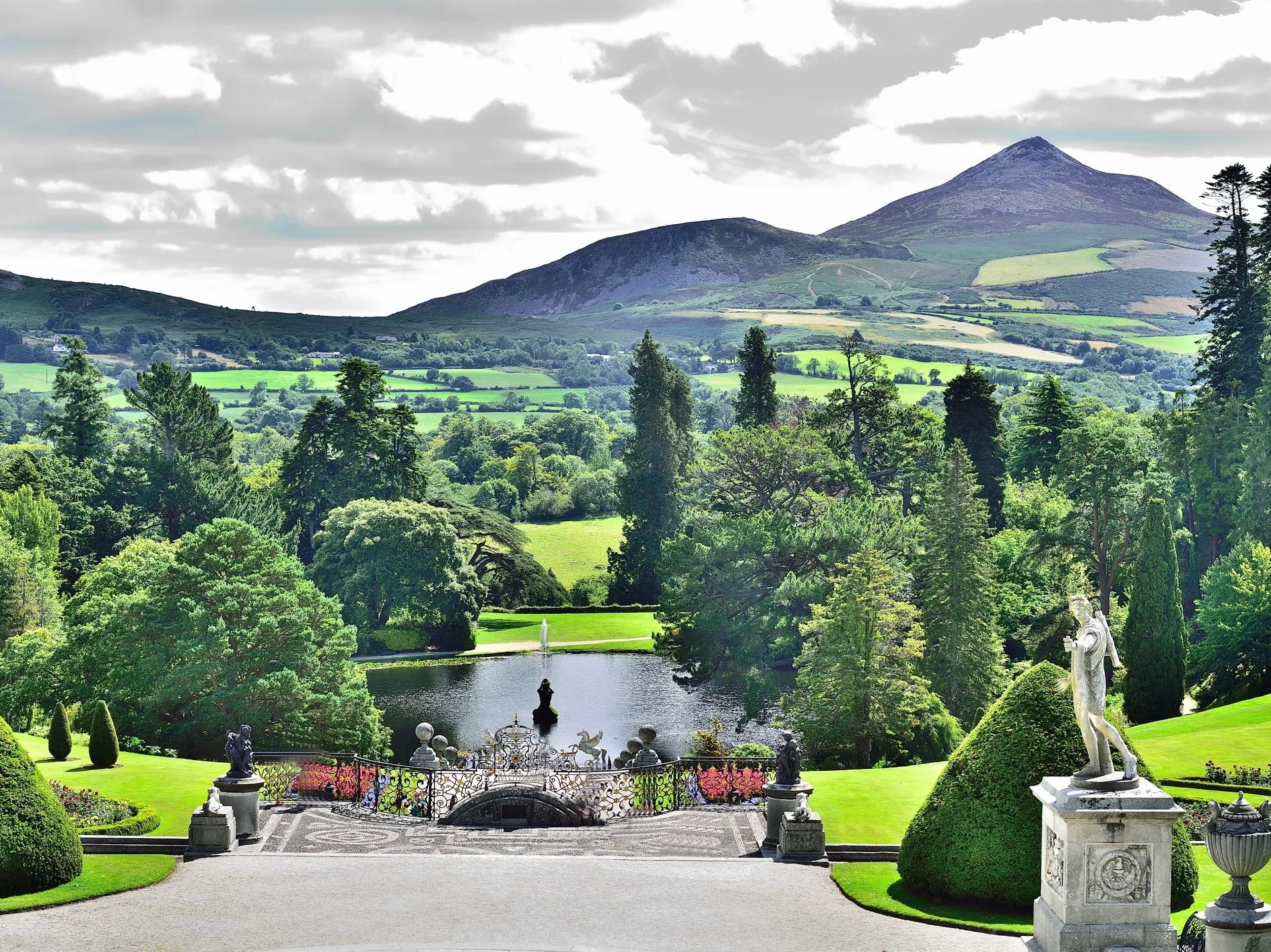
Powerscourt, Blenheim, the Italian villa garden — country houses and garden estates where beauty was accumulated over centuries, not commanded in a single reign.
The English country house is not a palace — it is something more personal than that. Highclere Castle in Hampshire, known to most visitors as Downton Abbey, is a Victorian baroque fantasy set in a Capability Brown landscape park, with Egyptian antiquities in the basement and a walled garden that produces cut flowers for the house; but what makes it affecting is the sense of a family still living inside a history they did not entirely choose. Blenheim Palace in Oxfordshire, birthplace of Winston Churchill and the only non-royal, non-episcopal house in England to hold the title of palace, sits in a park of such scale that the lake alone took three years to create — yet even here, in the grandest of English houses, the feeling is less of a court than of a home that got somewhat out of hand. What these houses share is a particular quality: the sense that beauty here was never purely decorative, but always also agricultural, political and deeply personal — the expression of a family's relationship with a particular piece of land across many generations.
Ireland's great country houses carry a more complicated history, and are often more beautiful for it. Powerscourt in County Wicklow is one of the finest garden estates in Europe — a Palladian house set against the backdrop of the Wicklow Mountains, with formal terraces descending to an ornamental lake, a Japanese garden, a walled kitchen garden and a tower folly on a distant hill, all laid out across forty-seven acres that have been shaped and reshaped since the eighteenth century. The house itself was gutted by fire in 1974 and has been partially restored; there is something quietly moving about a building that has survived so much and still commands such a landscape. Castletown House in County Kildare is the largest Palladian house in Ireland — built in the 1720s for William Conolly, then the richest man in Ireland and Speaker of the Irish Parliament, its Long Gallery decorated in the Pompeian style and its grounds running down to the Liffey. It was saved from demolition in the 1960s by Desmond Guinness and became the founding project of the Irish Georgian Society; to visit it is to understand both the ambition of the Anglo-Irish ascendancy and the fragility of what they left behind. Strokestown Park in County Roscommon is smaller and stranger — a Palladian house with one of the longest herbaceous borders in Ireland and, in its stable block, the Irish National Famine Museum, which documents the Great Famine of the 1840s with a directness and depth that makes it one of the most important historical sites in the country. The house and the museum together tell a story about Ireland that no single building could tell alone.
The Italian villa garden tradition is the oldest of all, and in many ways the most influential. The gardens of the Villa d'Este at Tivoli, outside Rome, were laid out in the 1560s and remain the model for every formal garden in Europe that followed — a hillside transformed into a sequence of terraces, fountains, grottos and water organs, the sound of moving water present in every part of the garden at once. The Villa Borghese in Rome, now a public park, preserves the bones of a seventeenth-century pleasure ground that once contained one of the greatest private art collections in the world; the sculpture gallery that remains on the site still holds Bernini's Apollo and Daphne and Canova's Pauline Bonaparte, two of the most astonishing works in any collection anywhere. On the western shore of Lake Garda, the Giardino dell'Isola del Garda occupies a small island that was once a Franciscan monastery — its Victorian neo-Gothic villa surrounded by formal Italian gardens, English parkland and a kitchen garden of extraordinary beauty, all reflected in the still water of the lake. Access is by boat only, visits are guided, and the number of visitors each day is strictly limited; it is one of the most quietly spectacular garden experiences in Italy, and almost entirely unknown outside the country.
These are places for the traveller who finds equal pleasure in the geometry of a clipped parterre and the wildness of a hillside in bloom — where architecture and nature have been coaxed, over centuries, into something neither could achieve alone.
Interested in exploring grand houses & gardens with us?
Plan Your Journey