
Art & History
Ancient Civilizations
Walk the streets of Pompeii, stand inside the Colosseum at dawn, or trace the Roman road through the French countryside — history you can touch.
Rome rewards those who arrive early. The Roman Forum at dawn is a place of extraordinary stillness — the ruins of temples, basilicas and triumphal arches that once formed the beating heart of an empire stretching from Scotland to Syria, now open to the sky and largely to yourself in the early morning light. The Pantheon, built in 125 AD and still intact, is perhaps the most astonishing building in the world — a perfectly proportioned dome with a single circular opening at its crown, through which a column of light moves slowly across the floor as the hours pass, exactly as it has for two thousand years.
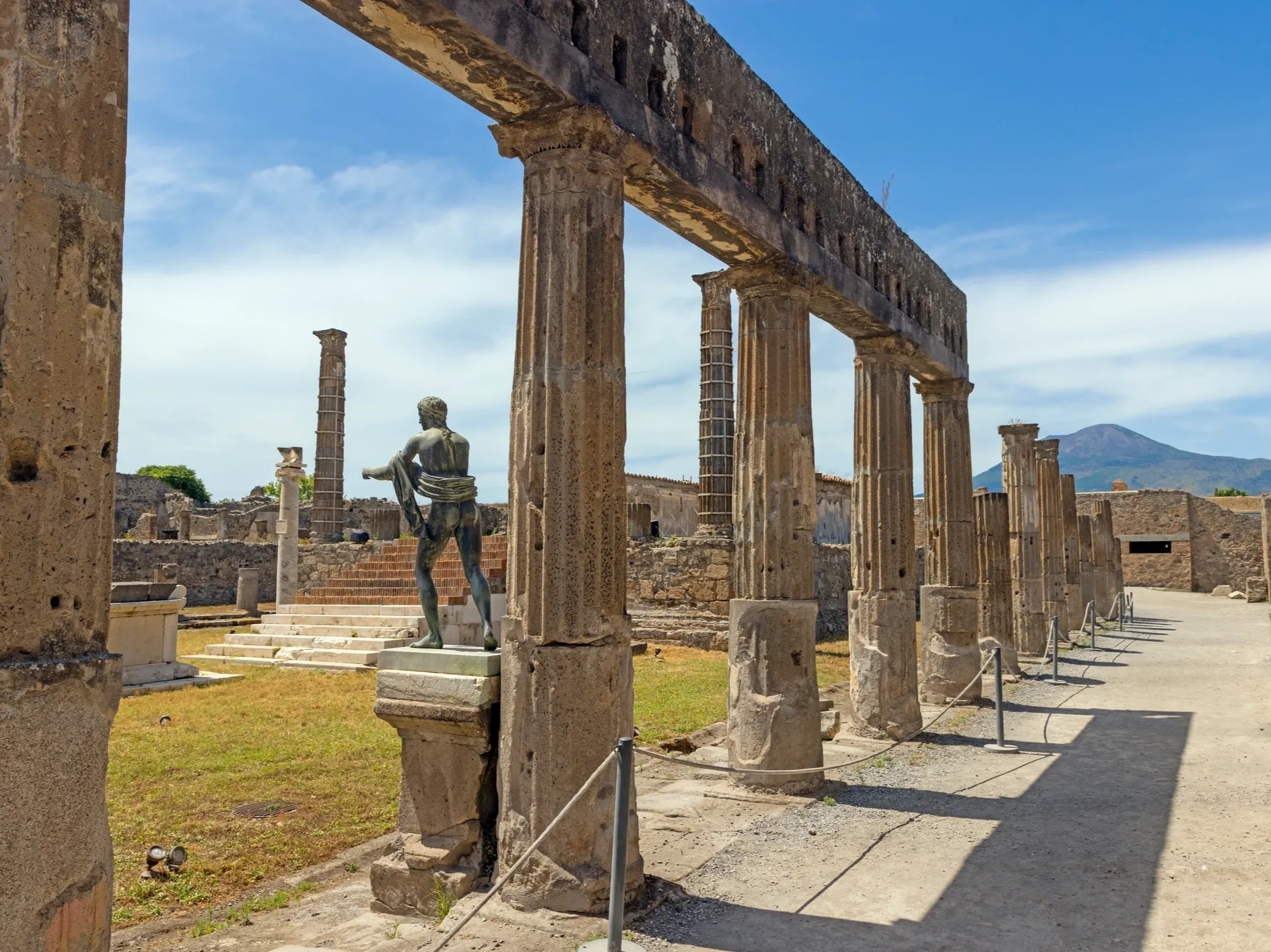
South of Naples, an entire Roman town lies preserved beneath volcanic ash — Pompeii and its quieter neighbour Herculaneum, where the eruption of Vesuvius in 79 AD buried streets, houses, furniture and frescoes so completely that archaeologists are still excavating today. Further south, at Paestum, three Greek temples stand in open fields with almost no one around them — older than the Parthenon, and in some ways better preserved. In Sicily, the Valley of the Temples at Agrigento lines a ridge above the sea with Greek columns that have stood for two and a half thousand years, in better condition than almost anything surviving in Greece itself.
In Ireland, the passage tombs of Newgrange and Knowth in the Boyne Valley were built five thousand years ago — older than Stonehenge, older than the Pyramids — their inner chambers aligned to the rising sun on the winter solstice with an accuracy that still astonishes. In England, the stone circles at Stonehenge and Avebury were raised by people who left no written record; at Avebury, the stones are so large that a village grew up between them, and you can walk among them freely.
In Spain, the Roman aqueduct at Segovia carries water through the centre of a living city on arches built without mortar — two thousand years old and still standing. And in Cantabria, the cave at Altamira contains paintings of bison, deer and horses made thirty-six thousand years ago, among the oldest art ever found; access to the original cave is strictly limited, but the replica museum beside it is one of the finest of its kind in Europe.
To stand in any of these places — inside the Pantheon as the light moves, at the edge of the Forum as the city wakes around it, or in the passage at Newgrange imagining the solstice dawn — is to feel the full span of human history beneath your feet.
Interested in exploring ancient civilizations with us?
Plan Your Journey